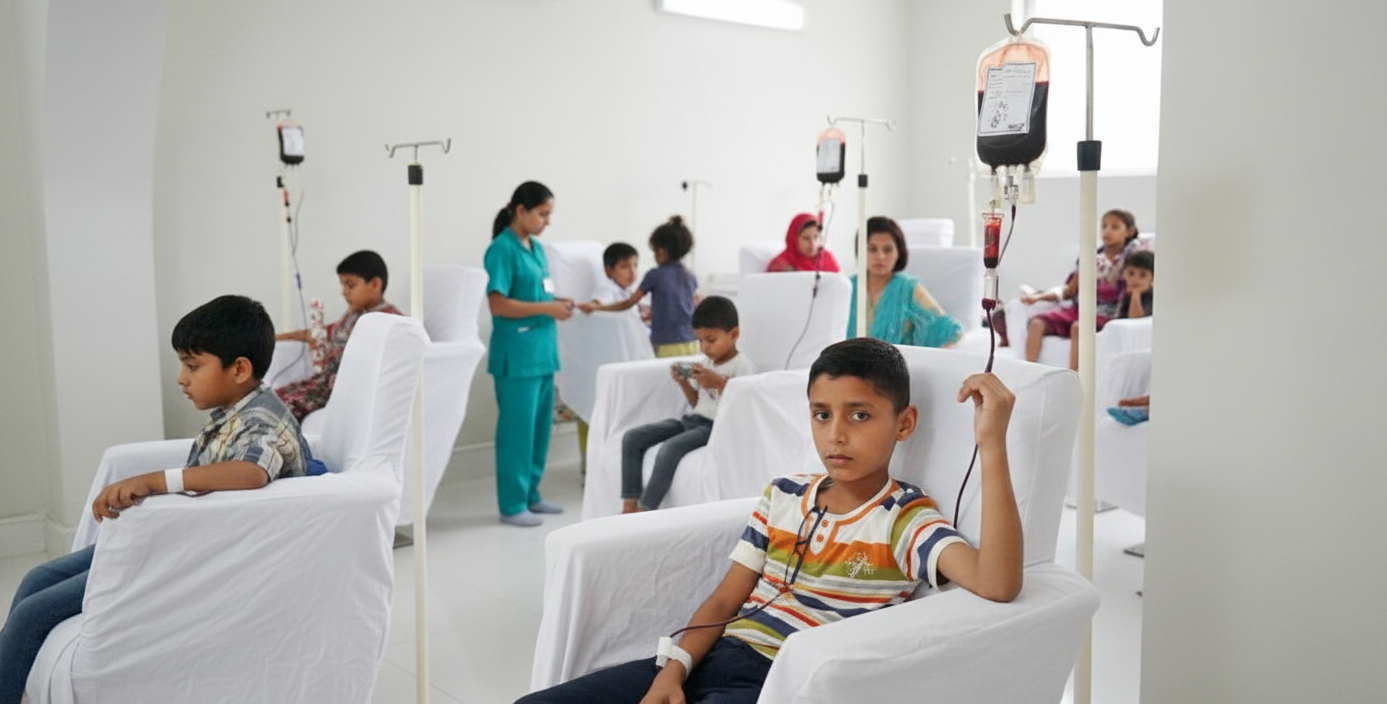
For three-and-a-half-year-old Abdul Hadi Nadir, life is a rhythmic cycle: energy ebbs as fever and pallor set in, signaling the urgent need for a blood transfusion. For his mother, 22-year-old Rimsha Nadir, this means yet another long day at a Lahore clinic, hoping the blood will arrive to restore her son's health for a few fleeting weeks.
Abdul Hadi is one of the youngest patients caught in a national crisis. He suffers from beta thalassaemia major, the most severe form of the genetic blood disorder that requires regular transfusions often monthly, stretching from morning until evening to survive. Rimsha says the treatment is immediate relief: "After he gets [the blood], then he eats everything."
The National Burden
Pakistan lies in the "thalassaemia belt," and the disorder is the country's most common severe genetic disease.
-
100,000 people are officially registered as thalassaemia major patients.
-
Over 5,000 children are born with the disease each year.
-
The average lifespan for a child born with the disorder in Pakistan is sadly just 10 years.
Rimsha and her husband, who lost a nephew to the disease at age nine, only discovered they were carriers (thalassaemia minor) after their son’s diagnosis. This lack of awareness is widespread: the estimated carrier rate in Pakistan is 5 to 7 percent, translating to 13 to 18 million carriers in a country of over 251 million people.
"If both parents are carriers, in every pregnancy there is a 25 percent chance that a child is born with thalassaemia major,” explains Dr. Haseeb Ahmad Malik, medical director of the Noor Thalassemia Foundation, where Abdul Hadi receives free care.
The Daily Struggle and Dimmed Dreams
The burden on families is immense. Access to the few treatment centers, mostly located in large cities, is a struggle for those relying on poor public transport from peripheral areas. Even at clinics like the Noor Foundation, blood supplies are often dangerously low, with donations declining during Ramadan, extreme weather, and national crises.
For patients like Muhammad Ahmad Dildar, 22, the cycle defines existence. Despite being one of the most compliant patients at the Noor Foundation, never missing his twice-monthly appointments, the symptoms—low blood pressure, fever, and back pain always return.
Muhammad, who dropped out of school due to lengthy bouts of illness, has already outlived the average life expectancy for the disease. His future is clouded by uncertainty. "Sometimes I am very afraid," he says, his voice cracking. "I’ve never thought about any dreams for myself… I’ll just keep getting my blood and keep living."
The Costly, Elusive Cure
While blood transfusions sustain life, the only known cure is a bone marrow transplant (BMT).
Thirteen-year-old Mudassir Ali of Rawalpindi is one of the rare success stories. Diagnosed at 16 months, he received a life-changing BMT at age four. His father, Muhammad Naeem Anjum, resolved to find the risky and costly cure, learning that the success rate dramatically drops after age 14 or 15. Mudassir's younger brother, Musaddiq, was found to be a 100% match, a genetic rarity that led to Mudassir's complete recovery.
However, for the vast majority of patients, the cure remains out of reach. BMT operations for thalassaemia are severely limited due to lack of funding and resources at the country's 12 transplant centers. As Dr. Syed Waqas Imam Bokhari, a BMT physician, notes, the capacity simply does not match the need.
Experts like Dr. Malik advocate for a national campaign to enforce premarital screenings to identify carriers. However, strong family bonds in Pakistan often mean couples commit to marriage even when they know they are both carriers, placing the burden of managing this devastating disease squarely back on the parents.