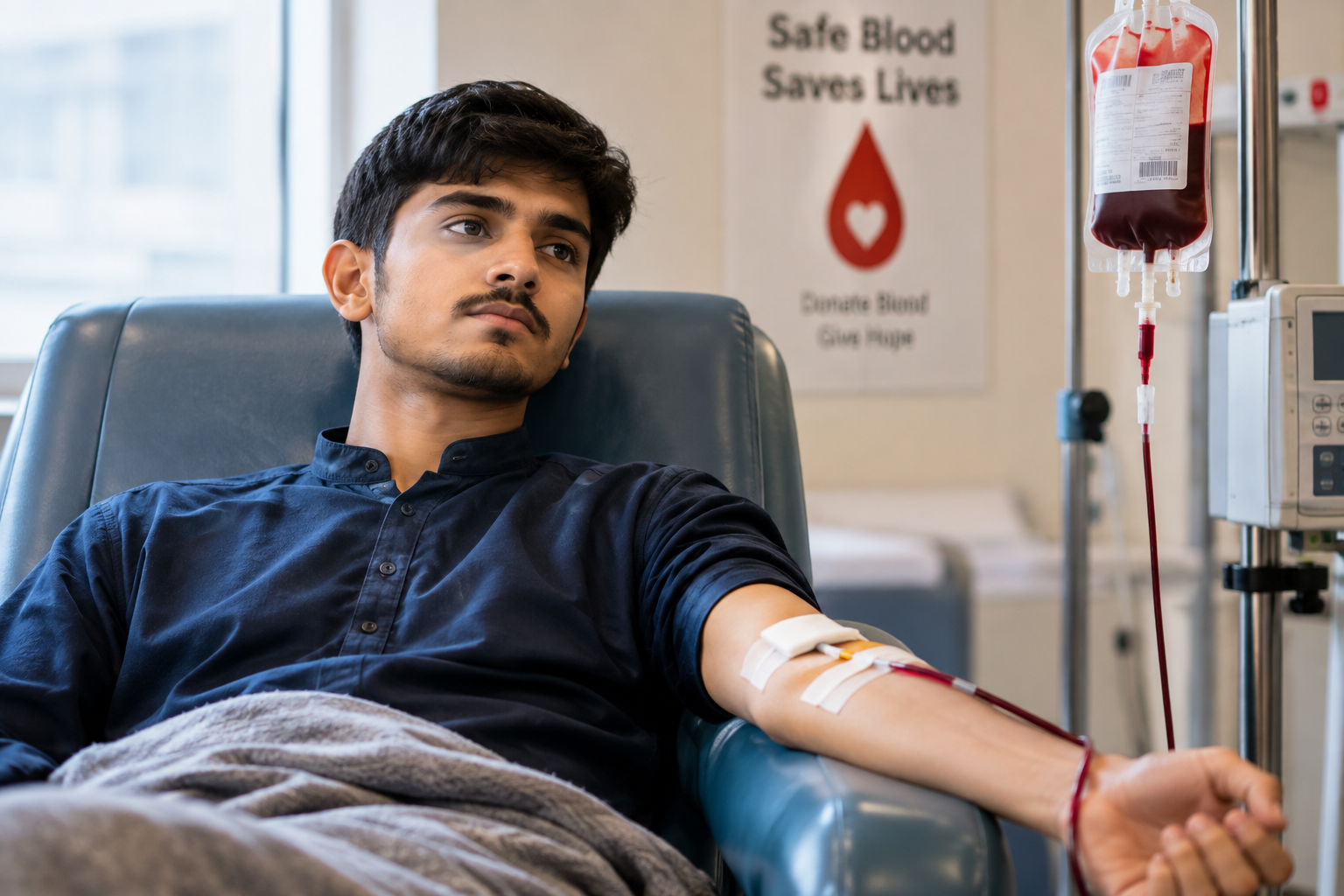
I used to think of blood donation as a pretty simple exchange.
Someone gives blood. Someone needs blood. The blood gets there.
Then I started looking into what actually happens when someone needs a transfusion in Pakistan.
The more I read, the less simple it became.
There are the people who need blood repeatedly. There are families trying to find donors. There are people who are willing to donate but may be turned away during screening. There are hospitals and blood centres that have to test, process and store what is collected.
And somewhere in the middle of all of that is a very basic problem: sometimes the person who needs blood and the person willing to give it simply cannot find each other in time.
For some people, needing blood is not a one-time emergency
For 22-year-old Muhammad Ahmad Dildar, blood transfusions have been part of his life since he was a baby.
He was diagnosed with thalassaemia major at three months old. By the time he was 22, he had spent nine years coming to the Noor Foundation clinic on his own for treatment.
He goes roughly twice a month.
He knows when his next visit is approaching because the symptoms start coming back. His blood pressure drops. He gets a fever. His back hurts.
“Life is very tough,” he told Al Jazeera.
Muhammad has already had to give up part of the life he might otherwise have had. Infections left him bedridden for long periods and eventually forced him to leave school in the ninth grade.
Yet he still goes to work, driving for a local ride-hailing service, and makes the trip to the clinic himself.
His treatment depends on something most people rarely have to think about: there being blood available when he needs it.
And Muhammad is not unusual in this respect.
In Lahore, Rimsha Nadir brings her three-and-a-half-year-old son Abdul Hadi to the same clinic. He was diagnosed with beta thalassaemia major when he was just nine months old.
When the fever comes, his skin turns yellow and he stops eating. His mother knows what comes next.
Another trip to the clinic.
Another transfusion.
Another long day.
Rimsha told Al Jazeera that after her son receives blood, “then he eats everything.”
That sentence stayed with me because it makes the situation feel very different from the way blood shortages are usually discussed.
It is easy to read a statistic about blood shortages and move on.
It is harder to forget a mother watching her child become weak and knowing that the thing he needs is something another person has to give.
Pakistan is not collecting enough blood
The scale of the problem becomes clearer when you look at the numbers.
In June 2025, the World Health Organization and Pakistan's Ministry of Health said medical centres in the country needed more than 5 million blood donations a year.
At the time, Pakistan was receiving around 2.3 million donations annually.
That leaves a substantial gap between what the health system needs and what it is receiving. WHO also reported that around 1.9 million of those 2.3 million donations, or 82%, came from family or replacement donors, while voluntary, non-remunerated donations accounted for only 18%.
That distinction matters.
A voluntary donor gives blood without being asked to replace blood already used by a particular patient.
A replacement donor is usually brought in because someone in their family or community needs blood.
The second system can work. But it can also put families under enormous pressure.
Imagine being told that a relative needs blood and then having to start calling everyone you know.
Brothers.
Sisters.
Cousins.
Friends.
Neighbours.
Then imagine doing it again the next month.
And again after that.
For families caring for people with conditions that require regular transfusions, this is not a single emergency. It can become part of everyday life.
Sometimes the family becomes the blood bank
This was visible in the story of Rimsha and her husband.
Their son needs regular transfusions, and when blood is in short supply, families may have to ask relatives to donate.
Moinuddin Haider, chairman of the Fatimid Foundation, described a similar experience from his own family.
His brother had two sons with thalassaemia. When his brother returned from army postings, he would gather the family and ask them to donate blood for the children.
At the time, Haider said, the family wondered what kind of disease could require so many people to keep donating.
The Fatimid Foundation eventually established one of Pakistan's early volunteer blood donation systems in 1978.
That history is important because it shows that Pakistan's blood shortage is not simply a story about people refusing to donate.
There have been people donating for decades.
The problem is that the system has often depended heavily on families finding donors when somebody is already sick.
That is a very different model from having a large, reliable pool of regular voluntary donors who can give before an emergency happens.
WHO's current global guidance continues to emphasize regular voluntary unpaid donors as an important foundation for a safe and sustainable blood supply.
But finding a donor is only part of the problem
There is another part of the blood story that is easy to overlook.
Not everyone who turns up to donate is actually able to donate that day.
A 2026 study at the Indus Hospital Blood Center in Karachi looked at 6,039 potential donors who were assessed between April and June 2023.
The average deferral rate was 27.4%.
Most of those deferrals were temporary rather than permanent. Among the temporary deferrals, the most common reasons were anemia, feeling unwell and recent antibiotic use.
That means the journey from “someone is willing to donate” to “a patient receives usable blood” has several steps.
A willing donor has to be eligible.
The donation has to be collected safely.
It has to be screened.
It may be separated into components.
It has to be stored properly.
It has to be available at the right time.
And it has to reach the patient who needs it.
WHO describes blood safety as a chain that includes collection, testing, processing, storage and distribution. It also notes that donated blood can be separated into components such as red cells, platelets, plasma and cryoprecipitate, allowing one donation to meet the needs of more than one patient.
So when we say that Pakistan needs more blood donors, that is true.
But it is only part of the picture.
The bigger question is how to make the entire chain work reliably.
Then there are the people who have nowhere else to turn
A March 2025 report by The Express Tribune described an elderly woman named Rakhshinda Bibi outside a government hospital in Peshawar.
Her 10-year-old son had thalassaemia.
She was asking passersby for blood.
The report said repeated rejections and delays at both private and public hospitals had left her with no other option.
There is something difficult to ignore about that image.
A person standing outside a hospital, asking complete strangers for something that could determine whether her child receives treatment.
It is one thing to know that a country has a shortage.
It is another to imagine what that shortage looks like from the other side of the hospital door.
For the person who needs blood, the national number does not matter very much in that moment.
They need one compatible supply.
They need it now.
And sometimes there is another way
Not every story ends with a lifetime of transfusions.
Al Jazeera also reported on 13-year-old Mudassir Ali, who was diagnosed with thalassaemia major when he was 16 months old.
As a child, he remembers getting tired easily and being unable to play like other children.
His father spent years searching for a treatment option and eventually pursued a bone marrow transplant.
The family then had to find a compatible donor.
Two of Mudassir's siblings turned out to be good matches. His younger brother Musaddiq was a full match.
Mudassir received the transplant in April 2016.
Almost a decade later, he had not needed another blood transfusion. He now hopes to become a doctor himself.
His story is different from Muhammad's and Abdul Hadi's.
But it reveals another part of the same problem.
Blood is not just something that exists or does not exist.
Access depends on donors, compatibility, screening, treatment centres, money, geography, medical expertise and timing.
Sometimes the person who can help is a family member.
Sometimes it is a stranger.
Sometimes the right donor exists but cannot be found.
And sometimes the treatment itself requires a different kind of donor entirely.
The geography matters too
Dr Haseeb Ahmad Malik, medical director of the Noor Thalassemia Foundation, told Al Jazeera that many treatment centres are concentrated in large cities.
For families living farther away, simply getting to treatment can become another burden.
Rimsha's journey to the clinic takes about half an hour by car. For patients travelling from peripheral areas on unreliable public transport, the journey can be considerably more difficult.
This is where the idea of “access” becomes more complicated.
A blood donation may exist somewhere in the country.
That does not necessarily mean the patient who needs it can access it.
The supply has to be where it is needed, when it is needed, in a form that can safely be given to the patient.
WHO makes the same point at the system level: blood collection, testing, processing, storage and distribution need to work together, with coordinated systems capable of providing safe blood products in sufficient quantities and in time.
So what is actually missing?
It would be easy to end this article by saying Pakistan needs more blood donors.
It does.
But after looking at the stories behind the numbers, that answer feels incomplete.
Pakistan needs more regular voluntary donors.
It needs people who understand the importance of donating before an emergency happens.
It needs systems that can identify people who are eligible to donate and keep them engaged.
It needs blood to be tested, processed, stored and distributed properly.
It needs patients outside major cities to have better access to treatment.
And it needs a better way of connecting people who are ready to help with people who urgently need help.
That last part sounds simple.
In practice, it can be the difference between a donor who is willing and a patient who actually receives blood.
Because the problem is not always that nobody is willing to give.
Sometimes the donor is there.
The patient is there.
The need is there.
They just have not found each other yet.
That is the gap platforms such as RedLife are trying to help close: making it easier for people who are willing to donate blood to connect with people looking for it when they need it.
And maybe that is what I found most interesting while researching this.
Blood donation is often talked about as an individual act.
One person gives.
Another person receives.
But the real story is much bigger than that.
It is about the chain connecting those two people.
The donor.
The patient.
The family.
The blood centre.
The testing.
The hospital.
The timing.
And, increasingly, the technology that can help connect them.
When that chain works, a donation becomes more than a bag of blood.
It becomes time.
It becomes another appointment.
Another birthday.
Another day at school.
Another ordinary morning that a family gets to have.
And for someone like Muhammad, another chance to simply keep living.
About the Author
Hassan Ridwan is a content writer and SEO analyst based in Lagos, Nigeria. He holds a BSc in Chemistry and writes about health, science, and everyday topics in a clear and easy-to-follow way. He’s excited to contribute to RedLife by helping make health information more accessible and supporting its work connecting blood donors with people who need them.
Sources
WHO/EMRO, “WHO and Pakistan urge 5 million voluntary blood donations a year to save lives,” June 23, 2025: https://www.emro.who.int/pak/pakistan-news/who-and-pakistan-urge-5-million-voluntary-blood-donations-a-year-to-save-lives.html
Urooba Jamal, “The Pakistani families caught in an endless cycle of blood transfusions,” Al Jazeera, October 19, 2025: https://www.aljazeera.com/features/2025/10/19/the-pakistani-families-caught-in-an-endless-cycle-of-blood-transfusions
“Blood, sweat and tears,” The Express Tribune, March 10, 2025: https://tribune.com.pk/story/2533215/blood-sweat-and-tears-1
Pre-donation deferral patterns in blood donor recruitment in a tertiary care hospital, Indus Hospital Blood Center, Karachi (2026 study, PubMed): https://pubmed.ncbi.nlm.nih.gov/42170397/
World Health Organization, Blood safety and availability fact sheet: https://www.who.int/news-room/fact-sheets/detail/blood-safety-and-availability