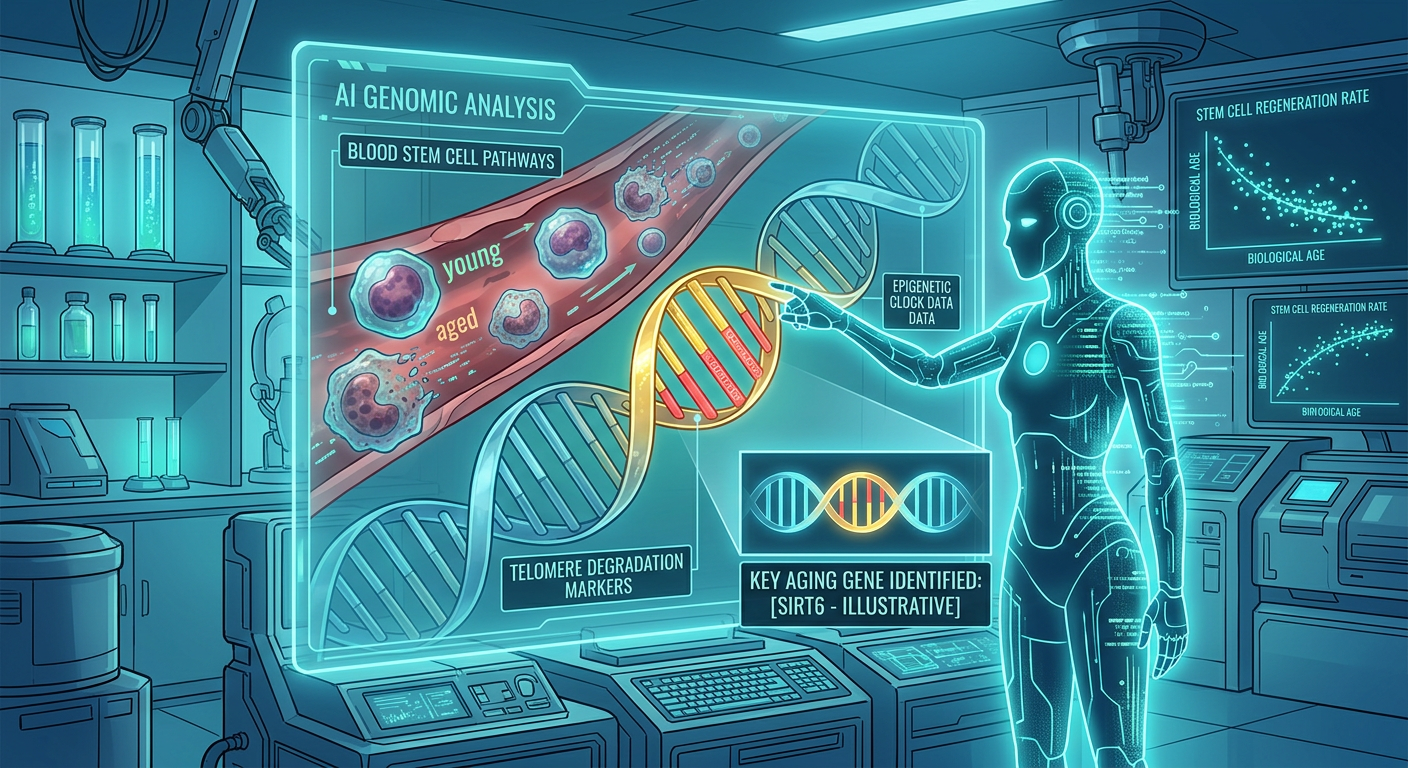
Stem cells can renew themselves and develop into different cell types, including the blood-forming cells needed to maintain a healthy blood system throughout life. However, as the body ages, hematopoietic stem cells in the bone marrow gradually become less effective, potentially contributing to anemia, weakened immunity, blood clots and age-related blood disorders.
Researchers at Tohoku University have used artificial intelligence (AI) to identify a key gene-regulating factor that may play a central role in this aging process. The findings provide new insight into the molecular changes that cause blood stem cells to shift their behavior with age.
AI identifies potential driver of stem-cell aging
The research team analyzed individual hematopoietic stem cells from mice at different stages of life. They discovered that aging stem cells simultaneously activate two distinct gene programs: one that maintains an immature stem-cell state and another associated with platelet production.
These changes developed gradually rather than appearing suddenly in old age. The immature stem-cell program began increasing before birth, while platelet-related genes became more active after birth, suggesting that the aging process involves a continuous shift in stem-cell behavior.
To identify genes responsible for these changes, researchers used Geneformer, an AI model trained on gene-expression data from around 30 million cells. The team further trained the model using data from approximately 160,000 young and aged blood stem and progenitor cells.
The AI analysis identified 143 promising candidate genes that could potentially influence the transition from a young to an aged stem-cell state.
Pbx1 emerges as a key regulator
Laboratory screening narrowed the candidates to Pbx1, a gene-regulating factor strongly associated with stem-cell immaturity, aging and platelet production.
When researchers increased Pbx1 activity in young blood stem cells, the cells developed several characteristics commonly observed in aged stem cells. Up to 73.3% of the genes activated by Pbx1 were also more active in naturally aged stem cells.
Transplantation experiments in mice provided further evidence of Pbx1's role. Stem cells with increased Pbx1 produced fewer red blood cells and showed a relative increase in platelet production. Researchers suggested that Pbx1 may contribute to reduced red blood cell development by suppressing another gene, Gata1.
New insight into how blood stem cells age
The researchers said the findings challenge the idea that aging blood stem cells simply become weaker. Instead, aged stem cells may enter a distinct and relatively stable biological state that changes their preferred patterns of blood-cell production.
The study combined AI-based gene prediction, large-scale screening, multi-omics analysis and animal transplantation experiments to identify a potential pathway involved in hematopoietic stem-cell aging.
Future research will investigate whether the same mechanism occurs in humans and whether Pbx1-related changes contribute to conditions such as anemia, thrombosis, clonal hematopoiesis and blood cancers.
Kobayashi, H., et al. (2026). Geneformer-guided multiomics integration identifies Pbx1 as a network hub of hematopoietic stem cell aging. Science Advances. DOI: 10.1126/sciadv.aeb1346. https://www.science.org/doi/10.1126/sciadv.aeb1346