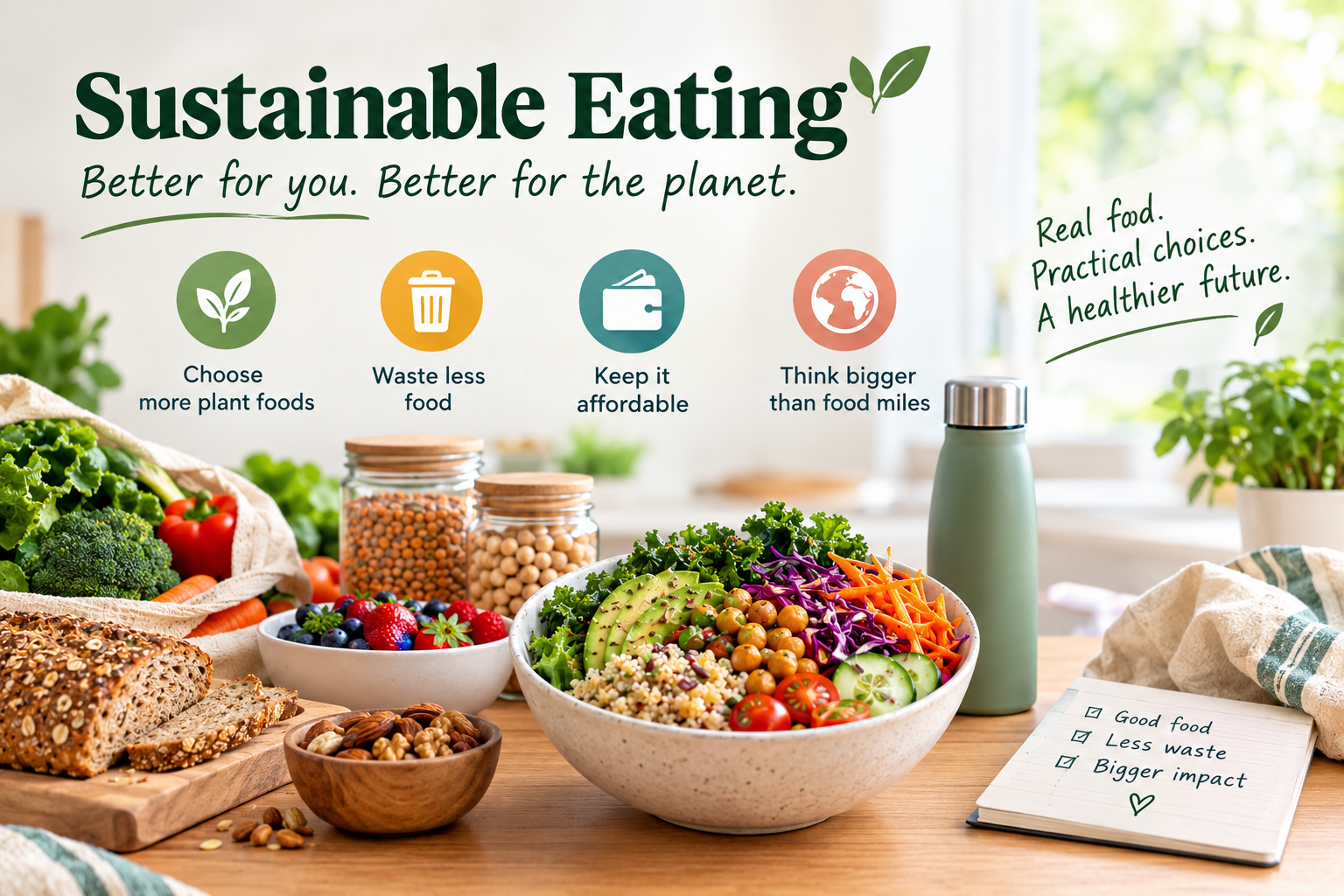
Sustainable eating is often treated like a shopping list. In reality, it is much more complicated—and much more practical.
When we hear the phrase sustainable eating, it is easy to picture farmers markets, reusable produce bags, organic vegetables, and a kitchen full of glass containers.
Those things can certainly be part of it.
But sustainable eating is not one specific diet, and it does not require eating perfectly.
That last part matters.
A diet cannot truly be sustainable if people cannot afford it, do not have access to the foods it recommends, or cannot realistically maintain it.
It Starts with what is on the Plate
Food production has a substantial environmental footprint. Agriculture uses large amounts of land and water and contributes significantly to greenhouse gas emissions.
That does not mean we need to eliminate entire food groups.
It does mean that what we eat matters.
Plant foods such as legumes, whole grains, fruits, vegetables, nuts, and seeds generally have lower environmental footprints than animal-based foods. The difference can be particularly large for beef and lamb.
This is one reason the FAO and WHO recommend dietary patterns built around whole grains, legumes, nuts, and a variety of fruits and vegetables, while allowing moderate amounts of foods such as eggs, dairy, poultry, and fish and smaller amounts of red meat.
For someone who eats meat regularly, sustainability doesn’t mean becoming vegetarian.
It could simply mean replacing a few meat-centered meals each week with meals built around beans, lentils, chickpeas, tofu, or other plant proteins.
There’s a much more realistic starting point for many people.
“Local” isn’t the Whole Story
Buying locally grown food can support farmers and communities, and seasonal produce can be a wonderful choice.
But if we’re talking specifically about climate impact, local does not automatically mean more sustainable.
Transportation accounts for only about 5% of food-system greenhouse gas emissions globally. Most emissions occur during land-use change and food production itself.
That means the environmental difference between two foods can be much greater than the difference created by how far those foods traveled.
For example, a locally produced beef product can still have a substantially larger carbon footprint than a plant-based protein shipped from farther away.
So rather than obsessing over food miles, it makes more sense to look at the bigger picture: what the food is, how it was produced, and how much of it is ultimately eaten.
Eating Sustainably Also Means Wasting Less
One of the simplest sustainable eating habits may already be sitting in your refrigerator.
Food waste is a major environmental problem.
That puts everyday decisions into perspective.
Planning meals around foods you already have, freezing food before it spoils, using leftovers creatively, understanding date labels, and buying only what you are likely to eat can all make a difference.
Sustainable eating doesn’t always require buying something new.
Sometimes it means using what you already bought.
Sustainability Has to Include People too
There is another part of sustainable eating that can get overlooked: affordability.
It is difficult to tell someone to build their diet around expensive specialty products, organic foods, or foods that are unavailable in their community and then call that sustainable.
A sustainable diet has to work within someone’s actual life.
Frozen vegetables can be sustainable.
Canned beans can be sustainable.
Store-brand whole grains can be sustainable.
Buying a larger package when you know you will use it can be sustainable. Buying less food when you know it will end up in the trash can be sustainable.
And sometimes the most sustainable choice is simply the food you can afford, prepare, enjoy, and actually eat.
The FAO and WHO specifically emphasize that sustainable healthy diets should be economically accessible, culturally acceptable, and adaptable to local circumstances.
It Doesn’t Have to be Perfect
Perhaps the biggest misconception about sustainable eating is that it requires perfection.
It doesn’t.
You do not have to grow your own vegetables, eliminate meat, shop exclusively at farmers markets, or buy everything organic.
You can start much smaller.
Add another plant-based meal to your week.
Choose beans or lentils more often.
Eat more fruit and vegetables.
Reduce the amount of food you throw away.
Buy foods that are in season when it makes sense for you.
Use what you already have before buying more.
And choose foods that support your health while fitting your budget, culture, preferences, and lifestyle.
Sustainable eating is not about finding the perfect diet for the planet.
It is about making food choices that are better for people, better for the environment, and realistic enough to keep doing.
Because the most sustainable diet isn’t necessarily the one that looks the most impressive on Instagram.
It’s the one people can actually live with.
Author: Katelyn Curtis
Author bio: Katelyn Curtis hold both a bachelor's and master's degree in food science and nutrition, and I'm passionate about making nutrition more approachable and grounded in real life. My work centers on an all-foods-fit approach, with an emphasis on balance rather than restriction and moving away from labeling foods as "good" or "bad"
I'm particularly interested in diabetes care and in breaking down trending nutrition topics in a way that is clear, evidence-based, and practical. Living with Type 1 Diabetes for the past 25 years has shaped my perspective and continues to inform my approach to nutrition - one that prioritizes sustainability, flexibility, and real-world application.