From the deepest oceans to the cells of newborn infants, synthetic chemicals known as per- and polyfluoroalkyl substances (PFAS) have become a global constant. You would be hard-pressed to find a blood sample today that doesn’t contain detectable traces of these "forever chemicals."
As experts uncover more links between PFAS exposure and serious health issues ranging from immune system suppression and kidney cancer to pregnancy complications the pressure to understand these chemicals has never been higher. Yet, while regulatory bodies debate safe exposure limits, thousands of PFAS variants remain unmonitored and unstudied.
As a researcher in chemical pollution, my work focuses on tracing these substances from their source—our cookware, food packaging, and water—to the "fingerprint" they leave behind in our bodies. By mapping how these complex mixtures transform once they enter a living organism, we are working to develop better safety guidelines for us all.
What Makes PFAS So Persistent?
PFAS are organic chemicals engineered with exceptionally strong carbon-fluorine bonds. This structural durability is a dream for manufacturers, as it makes materials resistant to heat, water, and oil. However, this same durability makes them an environmental nightmare.
Because they do not break down, PFAS leach from consumer products into our soil, air, and water, traveling across the globe to reach even the most remote ecosystems. Once in the body, their persistence doesn't vanish—it evolves.
Why Your Blood Tells a Story
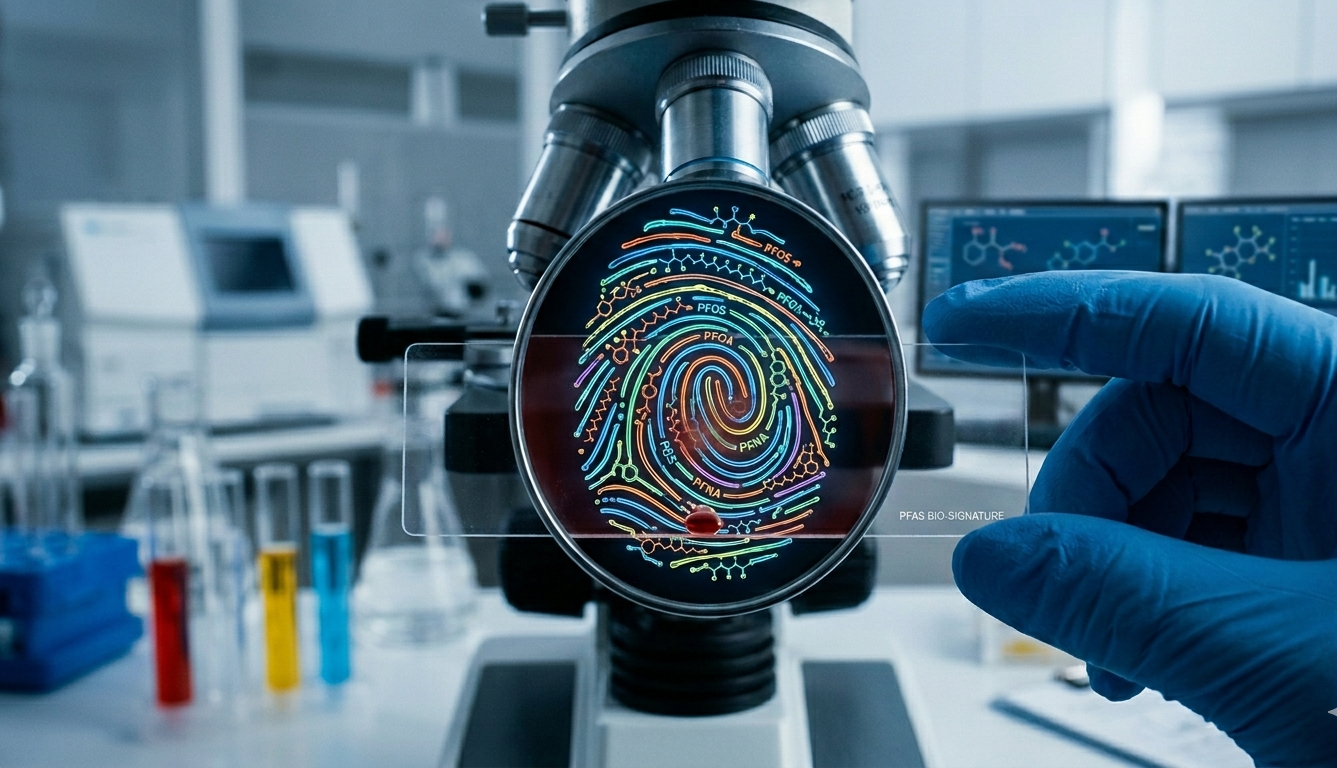
When you are exposed to PFAS, your body doesn't just store them; it processes them into a unique pattern of chemical accumulation. We call this a PFAS fingerprint.
However, this fingerprint isn't a direct reflection of what you were exposed to. Because your body absorbs and excretes different PFAS at different rates, your blood sample often looks very different from the water or food you originally consumed. Some chemicals, like PFOS, bind readily to proteins and fats, building up in your system at concentrations 50 to 100 times higher than what was present in your drinking water.
This "biological distortion" is one of the biggest challenges in my field. When we see a high level of a specific chemical in a person's blood, we have to determine:
-
Did this come directly from an exposure source?
-
Or is this a byproduct of the body metabolizing a different chemical into this final, persistent form?
For example, many PFAS used in firefighting foams eventually transform into the same few persistent chemicals once inside the body. This makes it difficult for researchers to trace an illness back to a specific workplace exposure, such as that of a firefighter or military service member.
The Path Forward
Understanding these chemical transformations is a race against time. We are currently working to identify specific biomarkers that can act as "smoking guns," allowing us to pinpoint the exact sources of contamination in a person's blood.
How to Protect Yourself: While science works to catch up, the best protection remains avoidance:
-
Be a Conscious Consumer: Utilize resources from organizations like the Green Science Policy Institute and the Environmental Working Group (EWG) to identify and avoid products containing PFAS.
-
Know Your Risks: While you can test your water and blood for common PFAS, remember that current testing cannot capture the full spectrum of thousands of unstudied chemicals.
-
Advocate for Change: The most effective path to safety is the industrial phase-out of non-essential PFAS. Until these substances are removed from our supply chains, the "fingerprints" in our blood will continue to be a silent record of our modern environment.